
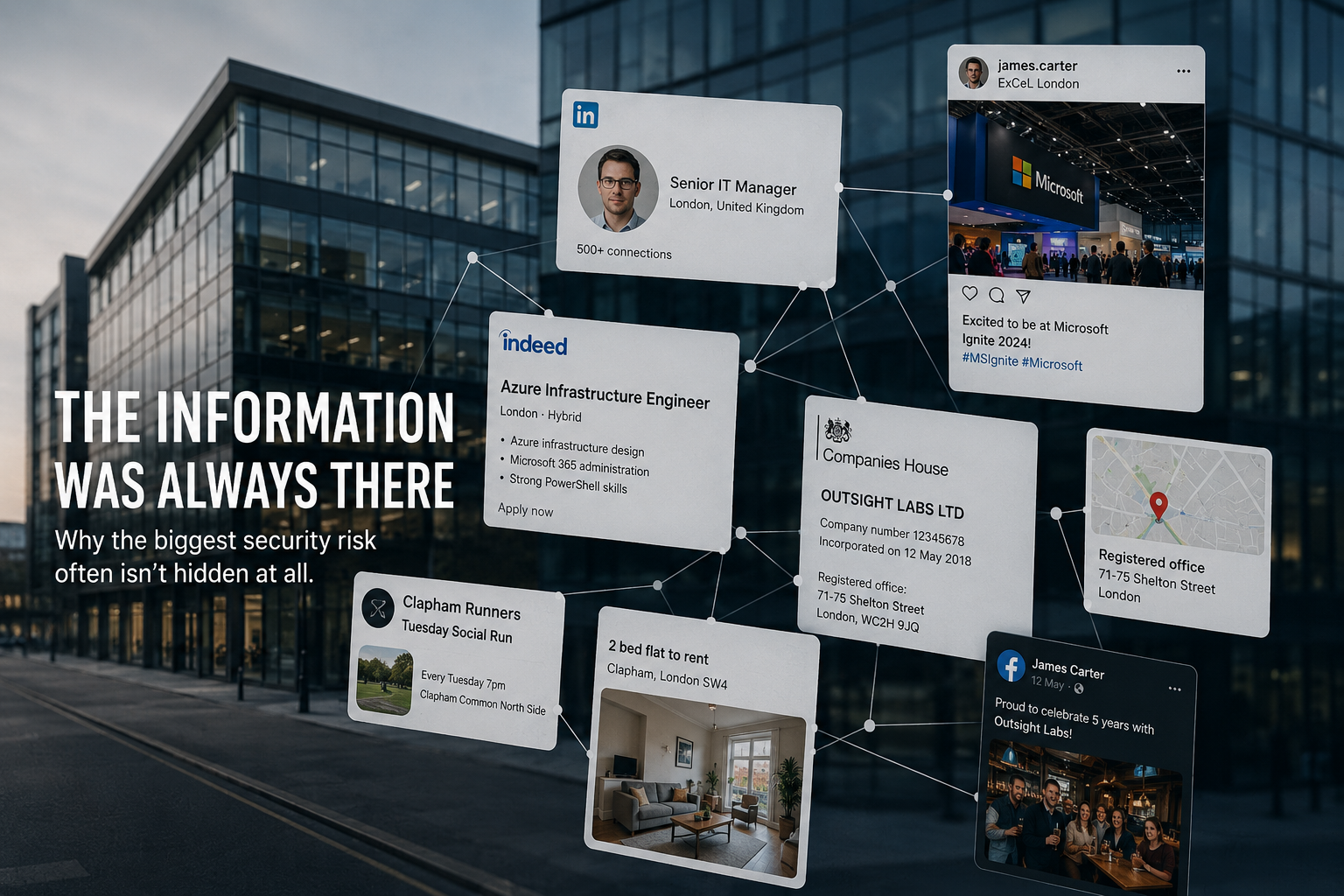
The Information Was Always There.
Why the biggest security risk often isn’t hidden at all.
Whenever a story about social media, privacy or online safety reaches the headlines, the conversation usually centres around regulation, platform responsibility or cyber criminals. Those discussions matter, but they often overlook something much simpler.
Not every security risk begins with someone breaking in. Sometimes it begins with information that was publicly available all along.
A LinkedIn post celebrating a promotion. A job advert for a new engineer. A Companies House filing. A photo from an office event. A conference badge in the background of a selfie. On their own, each of these seems harmless, and most of us scroll past them every day without giving them a second thought.
The problem is that information is rarely viewed in isolation.
An attacker is unlikely to stop after finding one LinkedIn profile or one social media post. Instead, they collect information from multiple sources, gradually building a picture of an organisation and the people within it. The end result is often far more detailed than most people expect.
This is where Open Source Intelligence, or OSINT, comes in. OSINT is simply the collection and analysis of information that is already publicly available. There is no hacking involved, no stolen passwords and no sophisticated exploits. The information is already there for anyone willing to spend the time looking.
These techniques are used every day by journalists, investigators, recruiters and security professionals. The difference is not the process. The difference is the purpose. A recruiter might use publicly available information to understand someone’s career history, while an attacker could use exactly the same information to identify decision makers, technologies, suppliers or potential targets for social engineering.
The real risk is not the information itself. It is what can be inferred from it.
Imagine a company advertises for an Azure Infrastructure Engineer. A week later, employees post photos from a Microsoft event, several technical staff list Azure certifications on LinkedIn, and the careers page references Microsoft 365. None of this information is confidential, but together it creates a clear picture of the organisation’s technology stack. That context influences how someone might approach the business, whether they are trying to sell to them, investigate them or target them.
The same principle applies to people. A LinkedIn profile shows where someone works. A running club publishes where they meet every Tuesday evening. A Facebook post confirms they have recently moved house, while a property listing provides photographs of the home. Each source reveals only a small piece of information, but together they can build a surprisingly detailed profile.
At Outsight Labs, we believe organisations benefit from looking at themselves from the outside. Not because everyone gathering information has bad intentions, but because understanding what is publicly visible is the first step towards understanding what someone else could infer from it.
That is why our methodology is built around three simple stages. First, Observe by identifying what information already exists across public sources. Then Interpret by understanding what those individual pieces reveal when viewed together. Finally, Simulate by demonstrating how those observations could influence decision making, social engineering or physical security through realistic scenarios.
Many organisations ask whether they are vulnerable to phishing. A more useful question is whether enough public information already exists to make a phishing email believable. Instead of asking whether someone could impersonate a senior manager, ask whether enough information exists online to do so convincingly. Those are different conversations, but they often lead to much more practical improvements.
Modern security rightly focuses on protecting systems with identity controls, endpoint protection and monitoring, but long before any of those defences come into play, someone has already decided who to target and how to approach them. Those decisions are frequently based on information that was publicly available from the beginning.
The information was always there.
The question is whether you’ve ever looked at it from someone else’s perspective.